 Atlas
Release 0.70.0
What changed in Atlas 0.70.0
Atlas 0.70.0 is the command atlas-code. It stops guessing where your code says nothing, works out what a call runs once for every question that asks, and writes into your tree exactly what it is asked to. A fault in one file or one call no longer ends the run, and Atlas now measures itself every night. Tensors that jaxtyping annotates now stand together by rank, a socket and an app.all route are the network the code says they are, and a view of Atlas itself draws in about a second once it is read. The Type lattice lights what you pick in the Flowchart, the history shows one commit on its own, and Studio's preview docks, folds and fills the window.
The command is atlas-code
Other tools install a command atlas too (ariga's database toolkit, MongoDB's Atlas CLI), so Atlas could not be installed beside them. Atlas's command is now atlas-code, as its Homebrew package already was, and the nightly's atlas-code-nightly; alias atlas=atlas-code keeps the short name. brew upgrade, atlas update and the install scripts move an earlier atlas over and remove it. The MCP server keeps its name, atlas, so its tools are named as before; an agent registered with atlas mcp is registered again with atlas-code mcp. And an update is now announced only once all of its files are there: Studio offered 0.69.3 while its installers were still being built.
Where the code says nothing, Atlas no longer guesses
A method called home() was your home directory to Atlas, whatever object it was called on, and so were joinpath, with_suffix, parent and Path(..): Atlas went by the name. Now a library's fact holds only where ty finds that library. Your own Archive.home() is followed into its own code, and where ty cannot say what a value is, the place keeps the name the code gives it instead of a guess. A class of your own named Path is yours too, and Atlas reads a project's pyproject.toml and ty.toml through the same one reading as the rest of its files.
with open(archive.home() / "log.txt", "a") as f: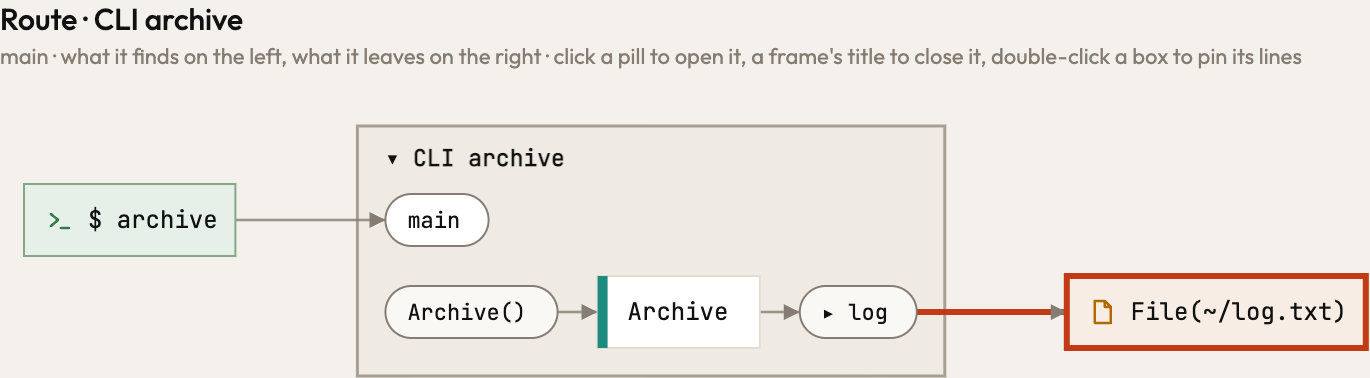
Paths shown right in a few more cases
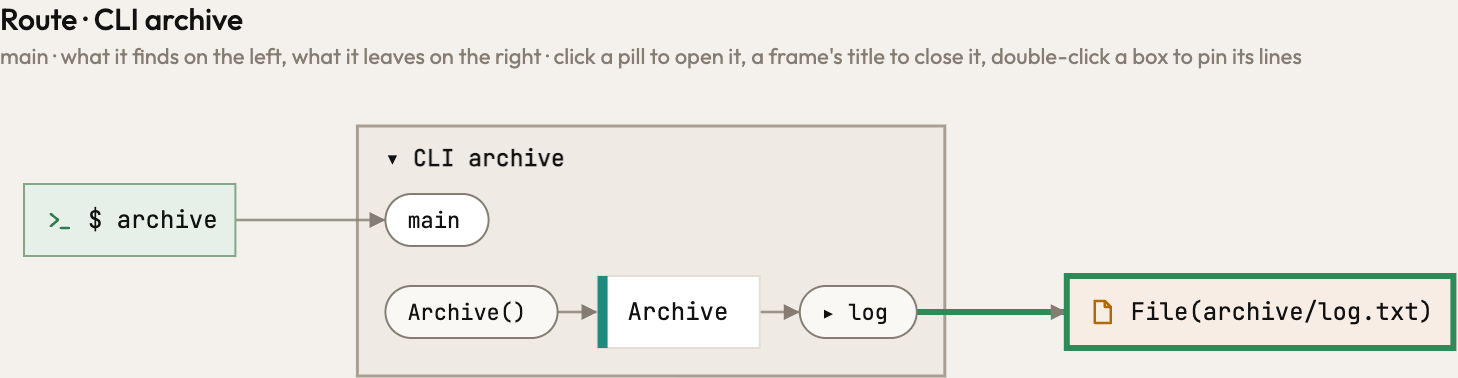
~/data/{name}/../shelf.log is now ~/data/shelf.log.

Tensors of one rank stand together
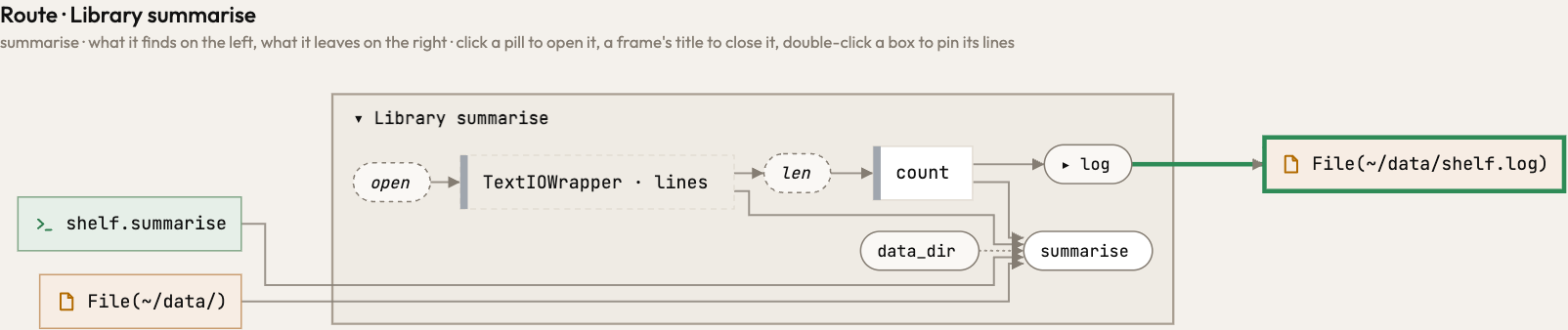
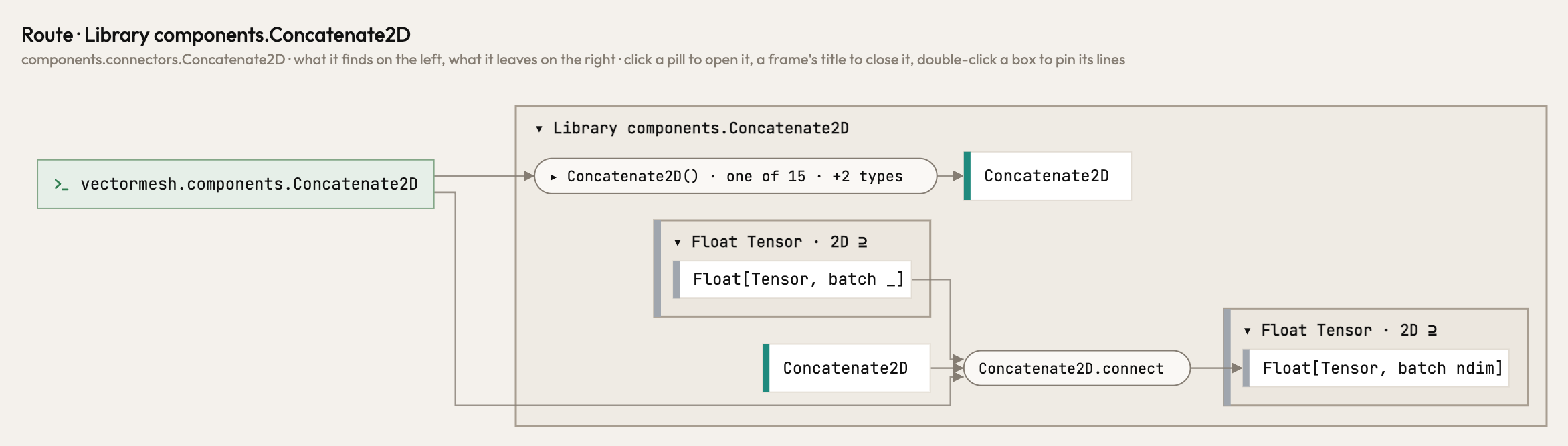
A program that annotates its tensors with jaxtyping (Float[Tensor, "batch dim"]) drew every shape as a place of its own, so a model's components read as many short, separate flows. Now each shape stands in its rank family, the way a subclass stands in its base class: Float Tensor · 2D stands for the rank-2 float tensors in the picture, and a click opens it into the exact shapes. Names still count (batch dim and batch ndim are two types of one family), and so does the dtype: an Int tensor never joins a Float family.
Concatenate2D takes a batch _ and gives a batch ndim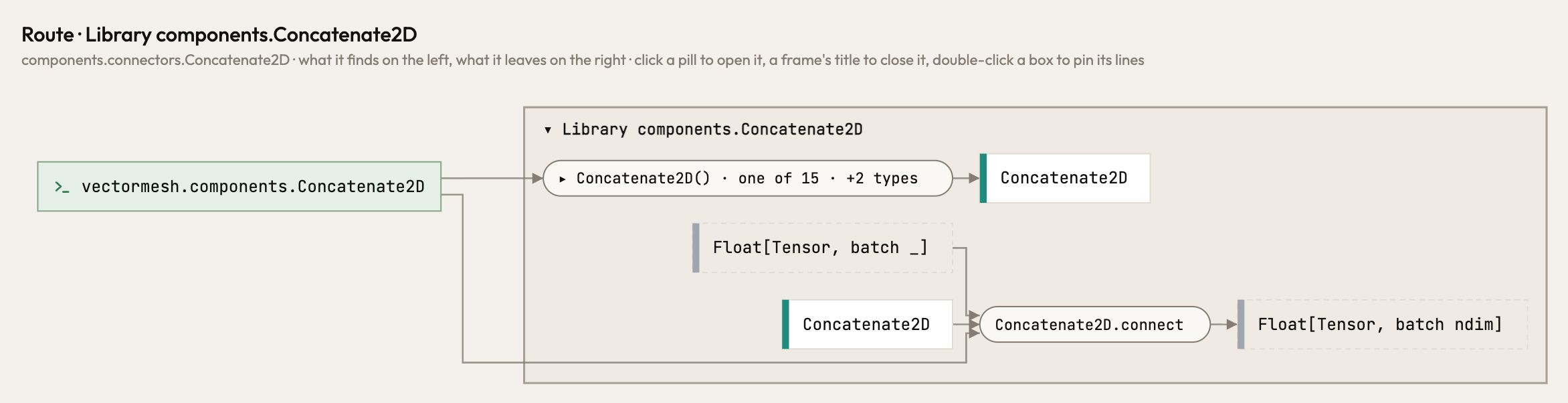
Float Tensor · 2D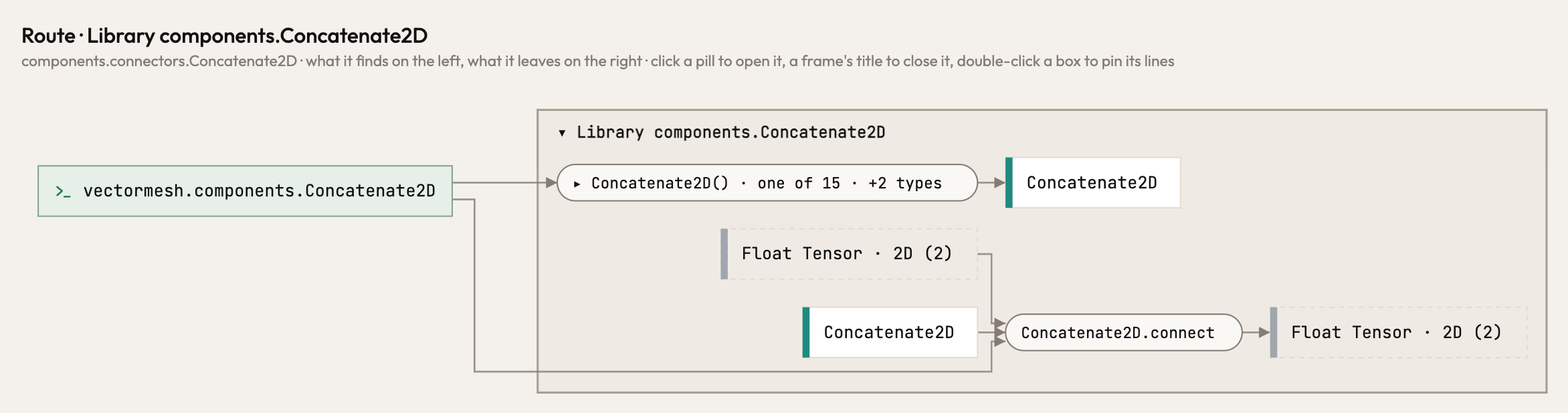
What a call runs is one answer
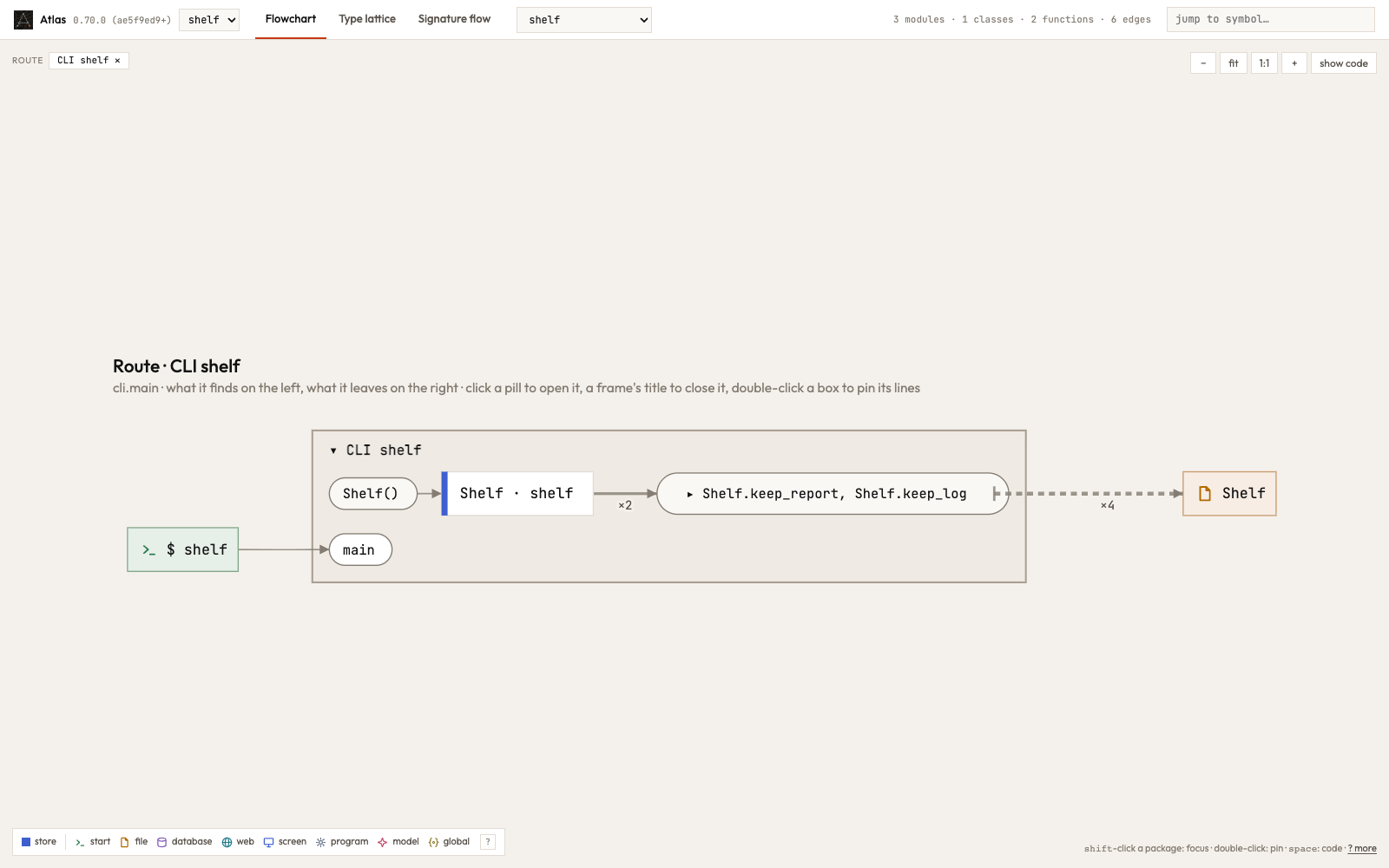
Which functions may this call run? The route, what a parameter holds and which errors a call hands on now all ask that one question, and get one answer. A value built at the call runs its own class's method; a value of a declared class may run every override below it; a call through a class runs that method and no override. The step says so too: a call that may run two functions reads Section.show · one of 2, named by the class it runs on. Rust is read by the same law: a unit struct's method (Plain.show()), a supertrait's method called on a &dyn Block, and a function named like its crate are followed into the code they run.
Each caller keeps the file it names
A shelf whose folder main sets up, and whose methods each name a file in it and hand the path to one write, drew both methods writing both files: where the path was handed more than one level up, Atlas dropped the method that names the file, so the two steps folded into one box that wrote the shelf four times. Now each method writes its own file, as the shortcut that writes each file in its method always drew it. Atlas's own workbench reads the same way: each of its seven .atlas files is written under the step that names it. And who makes a path whole is a set of callers, so the order Atlas happened to read them in no longer makes two answers of one.
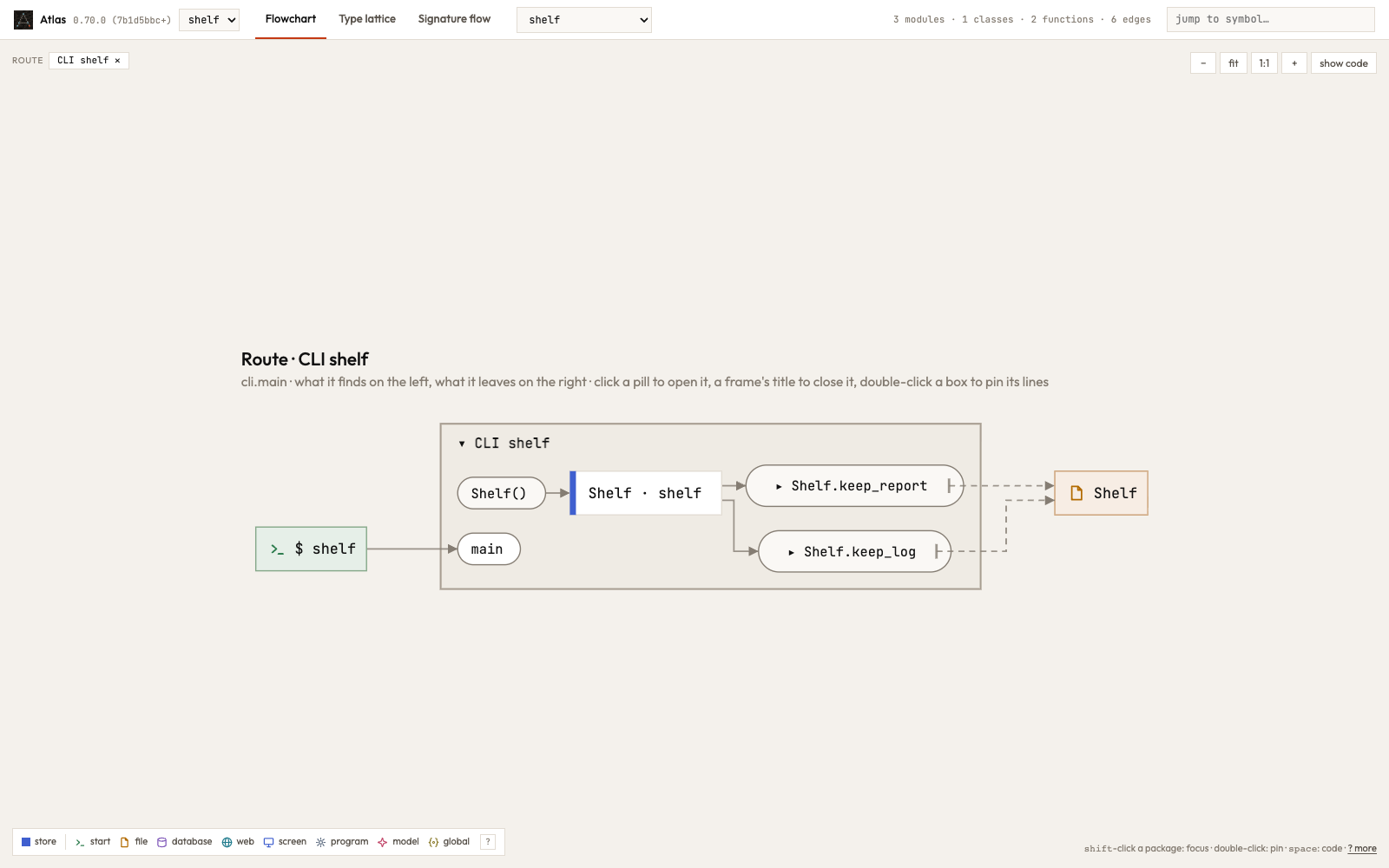
The network, as the code says it
A Rust server that reads from and writes to a TcpStream drew no place at all, and atlas-code check asked whether it did anything. What moves data on one of std's sockets (connecting, reading, writing, sending, receiving) now reaches the web, as it does through Python's socket; binding an address, accepting a connection and shutting a half move none. And an Express app.all(path, ..) route serves every method: a POST to its path met no route and left for the web, and now meets the handler in its own program. A route's methods are a set: methods=["POST", "GET"] and ["GET", "POST"] are the one route GET|POST /items, and atlas-code changes after swapping the two says nothing changed, where 0.69 reported a route removed and another added.
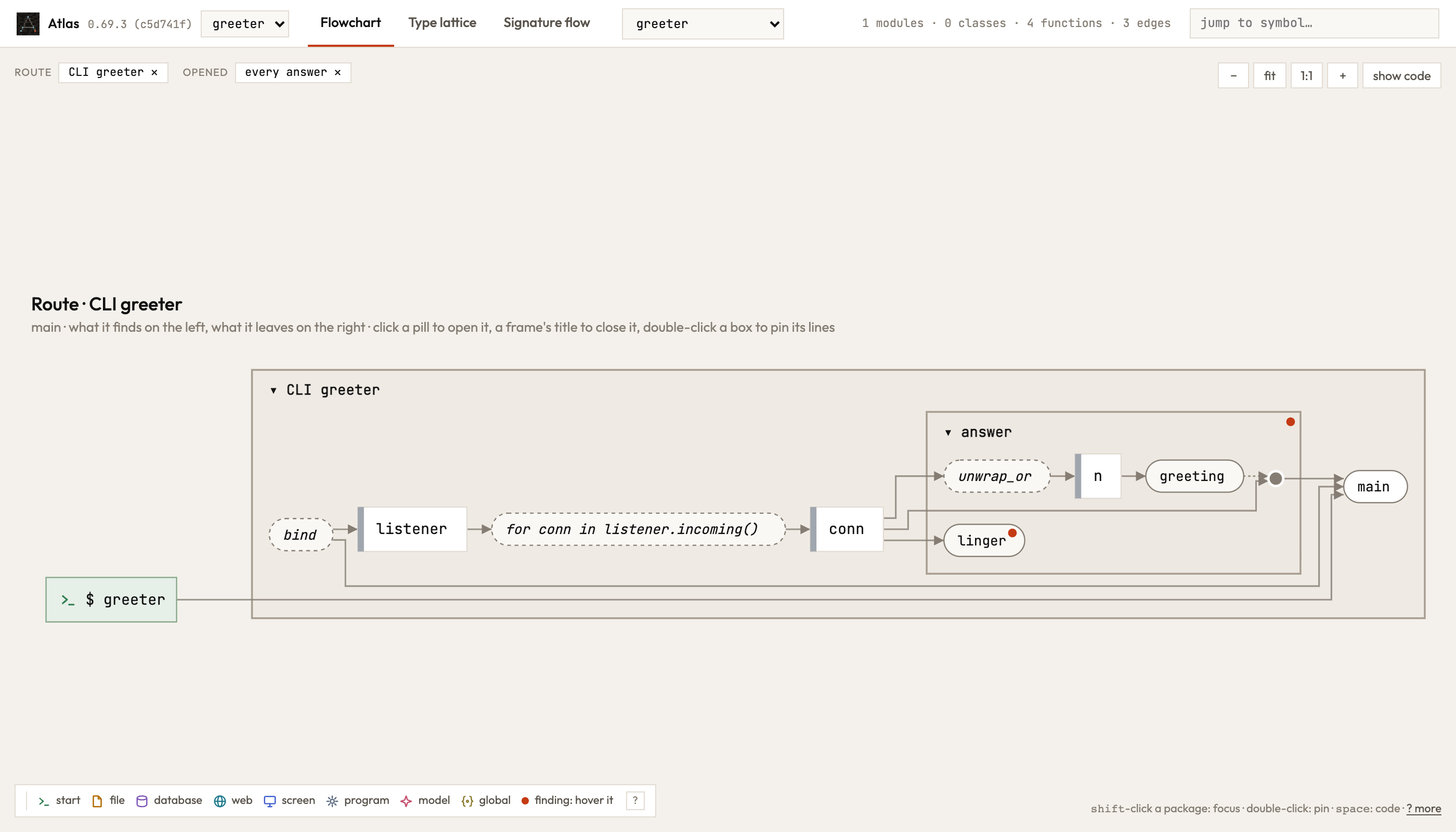
answer and linger reach the web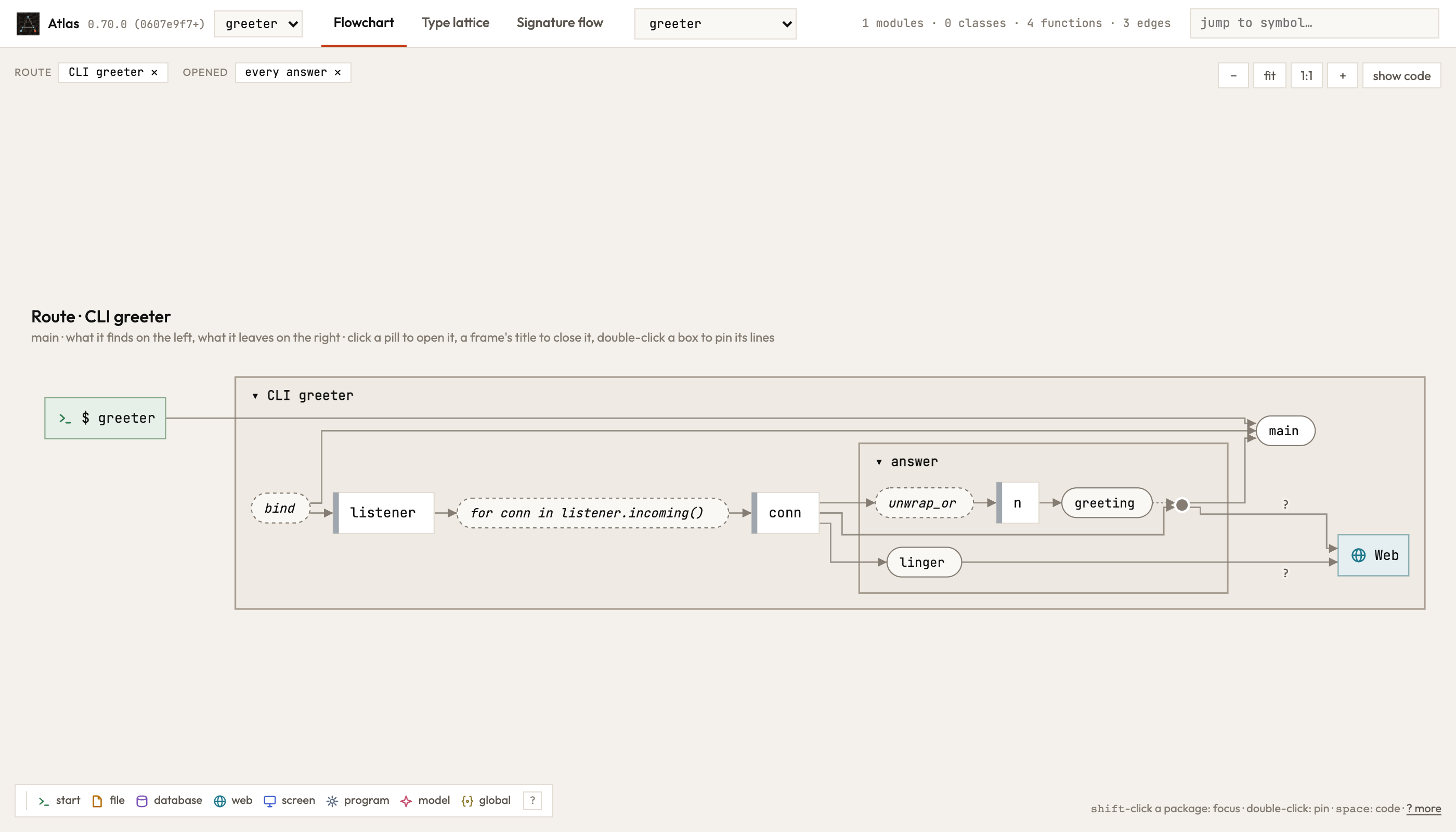
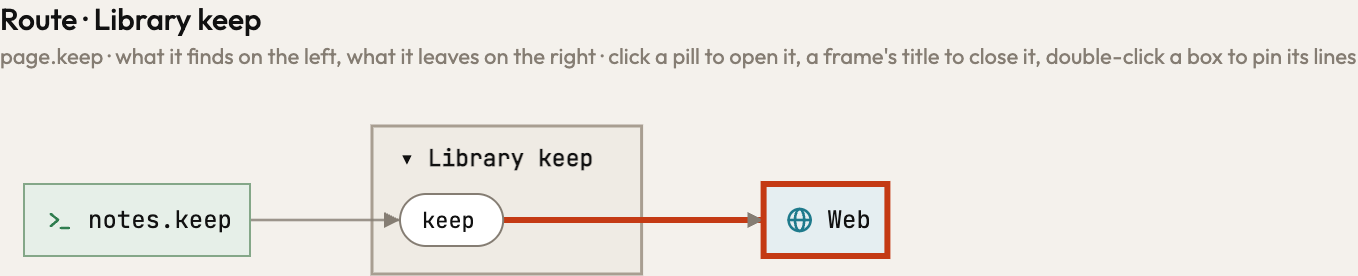
app.all route serves every method, the POST among them
The wheel zooms wherever the pointer is
The mouse wheel sometimes did nothing until + was clicked. Five strips over the picture took the wheel without using it: the empty part of the state bar, the zoom's buttons, the legend, the hint and the status bar. A drag let go outside the page (over Studio's bar) kept panning with every move after it; a wheel made while atlas-code serve hands the page a new reading was lost; and opening a box far larger than the window sank the scale below the zoom's floor, from where a wheel out jumped in. Now the wheel zooms wherever the pointer is and whatever the page is doing. And in Studio, scrolling and the trackpad over the view work from the first gesture, where they did nothing until + had been clicked.
The Type lattice lights what you pick
In the Type lattice, space over a class shows its details and code, as it does over a box in the Flowchart. A double click on a class opens the Flowchart on a route that holds a value of that class or of one below it, and lights every box of those types; the rest of the route stays, dimmed. A box that holds such a value inside (a closed step, a family holding it as a part) is lit dashed, and opening it shows the lit box. The rank families of jaxtyping shapes stand in the lattice too, above their shapes as a base stands above its subclasses: picking Float Tensor · 2D lights its closed boxes whole, picking one shape opens the family and lights that shape alone.
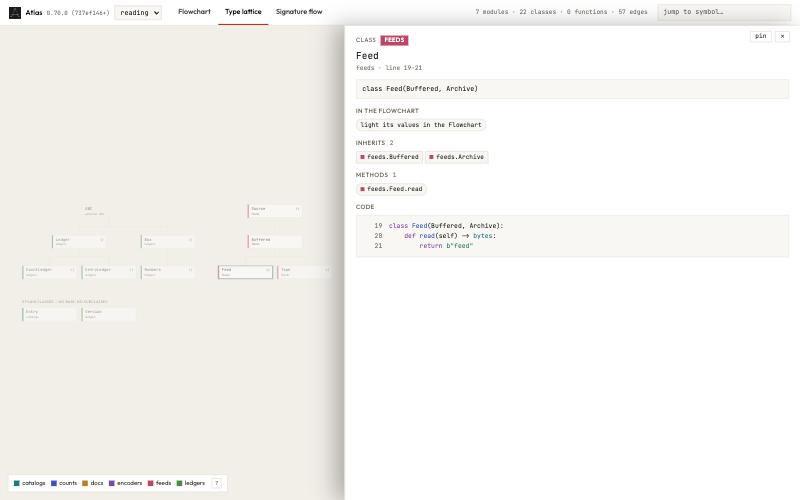
language.Language and the boxes that hold it, the rest dimmed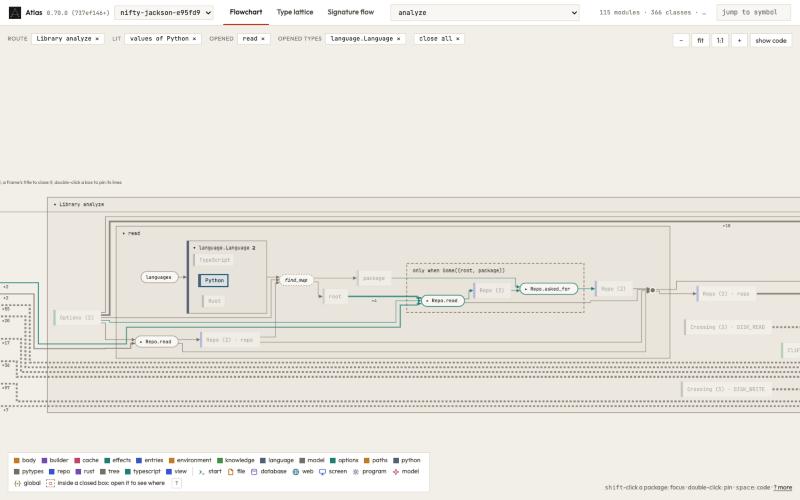
Float Tensor · 2D in Concatenate lit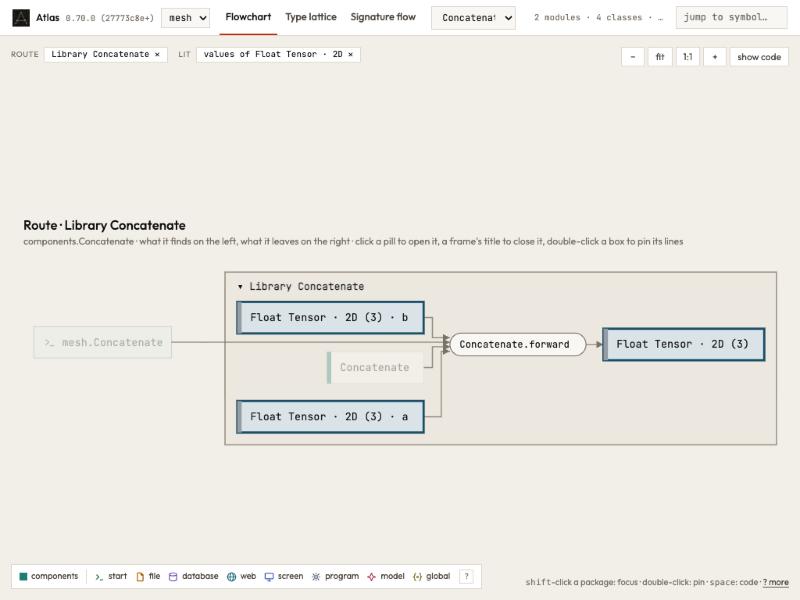
A box that stands for several opens into them
Siblings that draw the same lines are one box: in vectormesh's gating, MoE, Skip and SparseMoE all take a Module and a Float Tensor · ≥1D and give one back, and the package shows MoE, Skip +1. Before a route was chosen, a click on such a box only selected it, though its ▸ said it would open. Now it opens into its members, each drawing the lines the box drew, and a click on one opens it as a route. Closing them under opened draws the one box again.
MoE, Skip and SparseMoE as one box, which a click does not open

History shows one commit on its own
The history's top row is HEAD, a hollow dot, and the working tree gets a row of its own, Uncommitted changes, only while it holds changes. A click shows that commit on its own, read from the commit; a ⇧ click compares it with the one shown. files shows the commit's files instead of its picture, markdown rendered with its pictures. Right-click a commit to copy its hash or subject, add a tag, check it out, or pull and push the branch HEAD is on; each asks first and names the git command it runs.
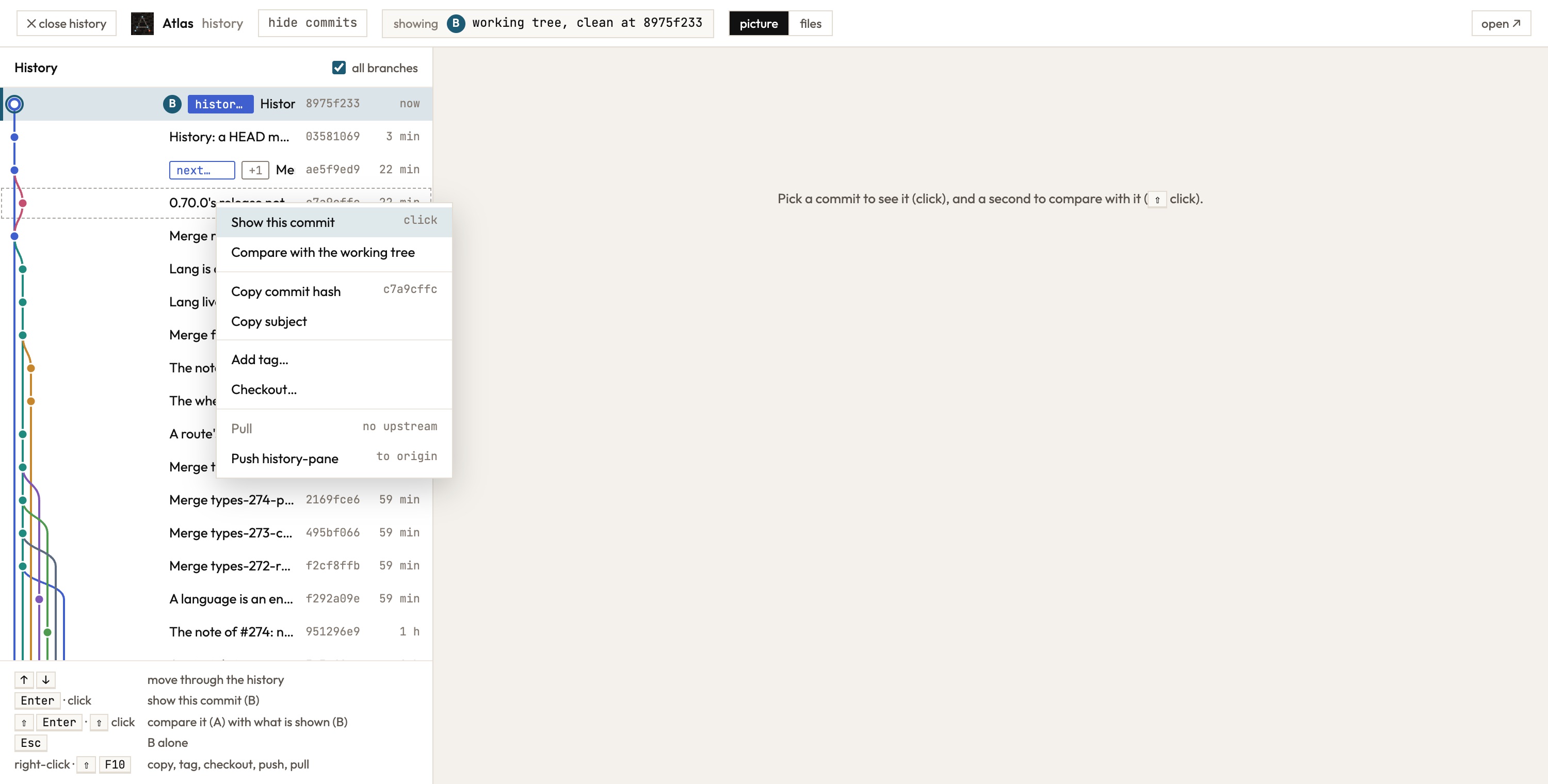
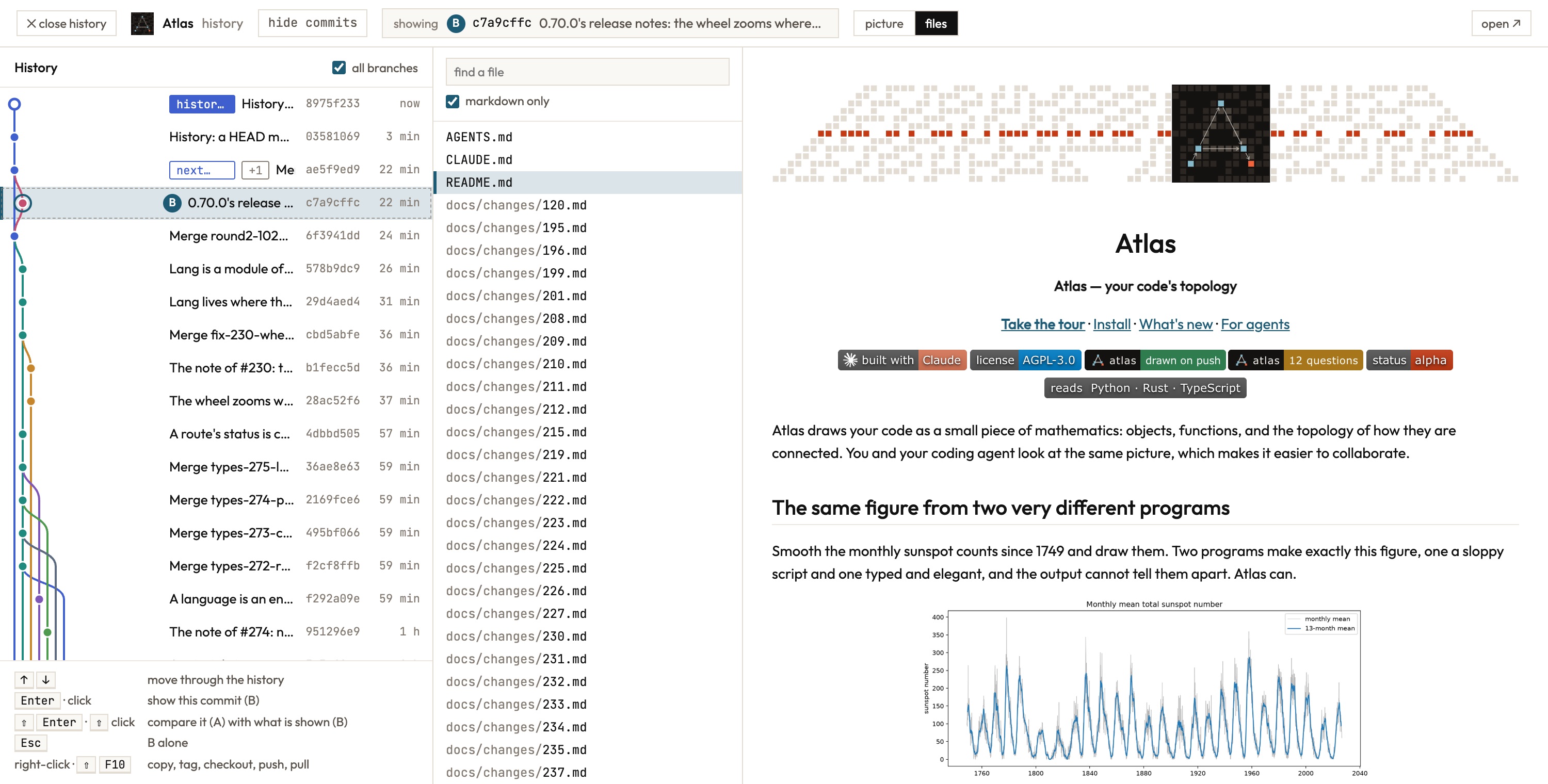
Studio's preview stands where you put it
The preview of a file in Studio (Markdown, HTML, source, a PDF, an image) stands where the terminal can: its inner edge drags, the buttons in its head dock it left or right, fold it to a narrow bar that names the open file, or let it fill the stage while the Atlas view keeps its size underneath. The version at the right of Studio's status bar is a button that shows What's New for the build that runs. And the README now says, step by step, what to do when macOS or Windows blocks Studio's first start: System Settings › Privacy & Security › Open Anyway, or More info › Run anyway.
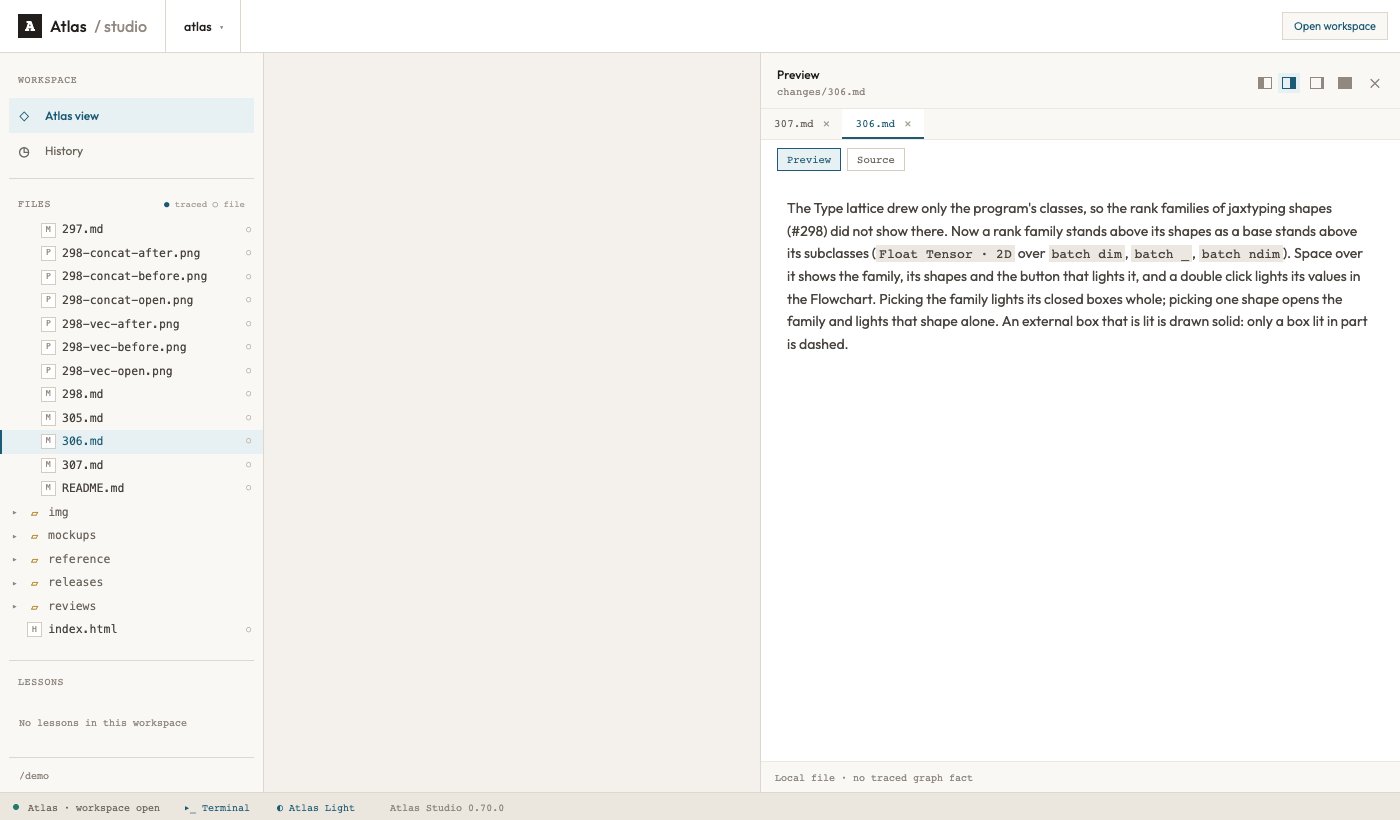
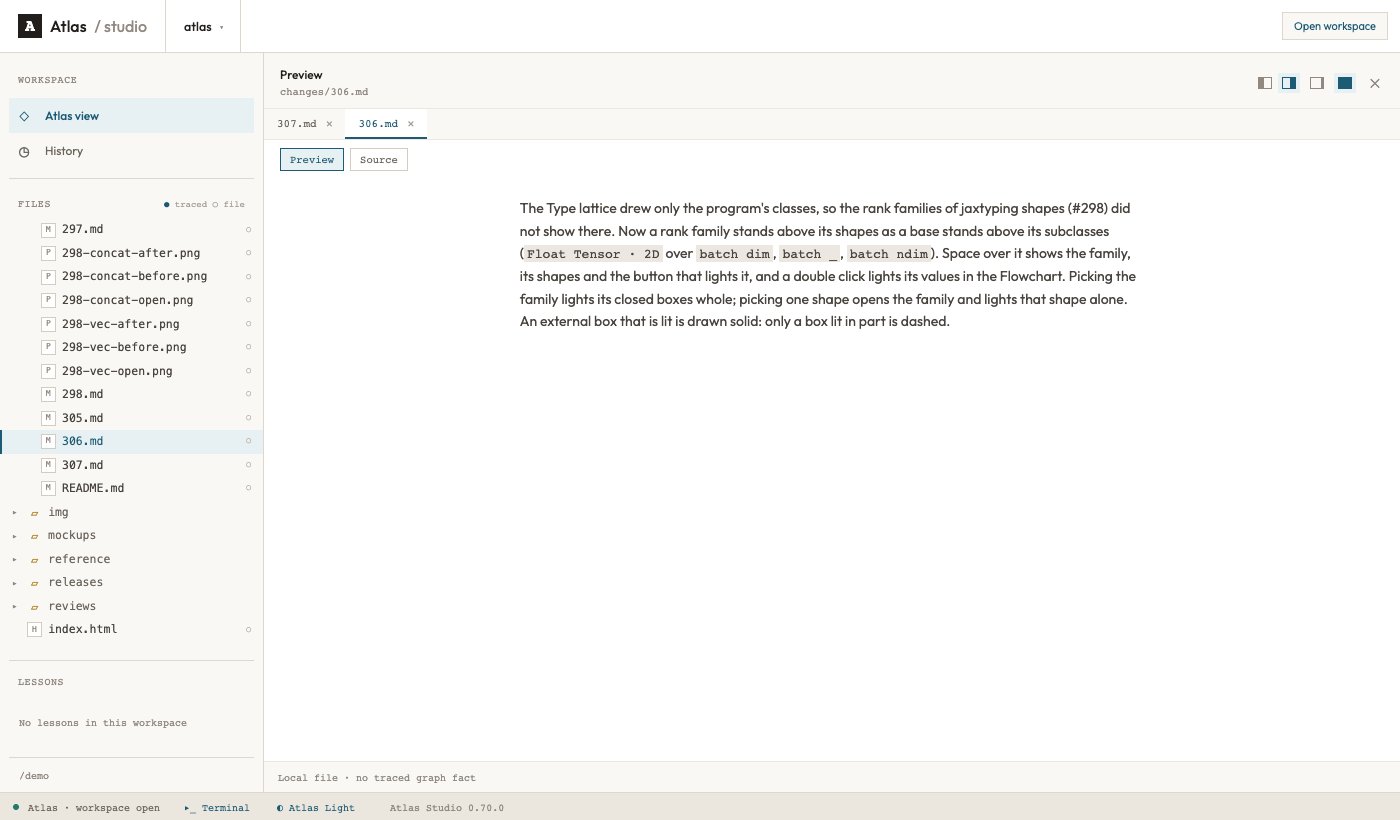
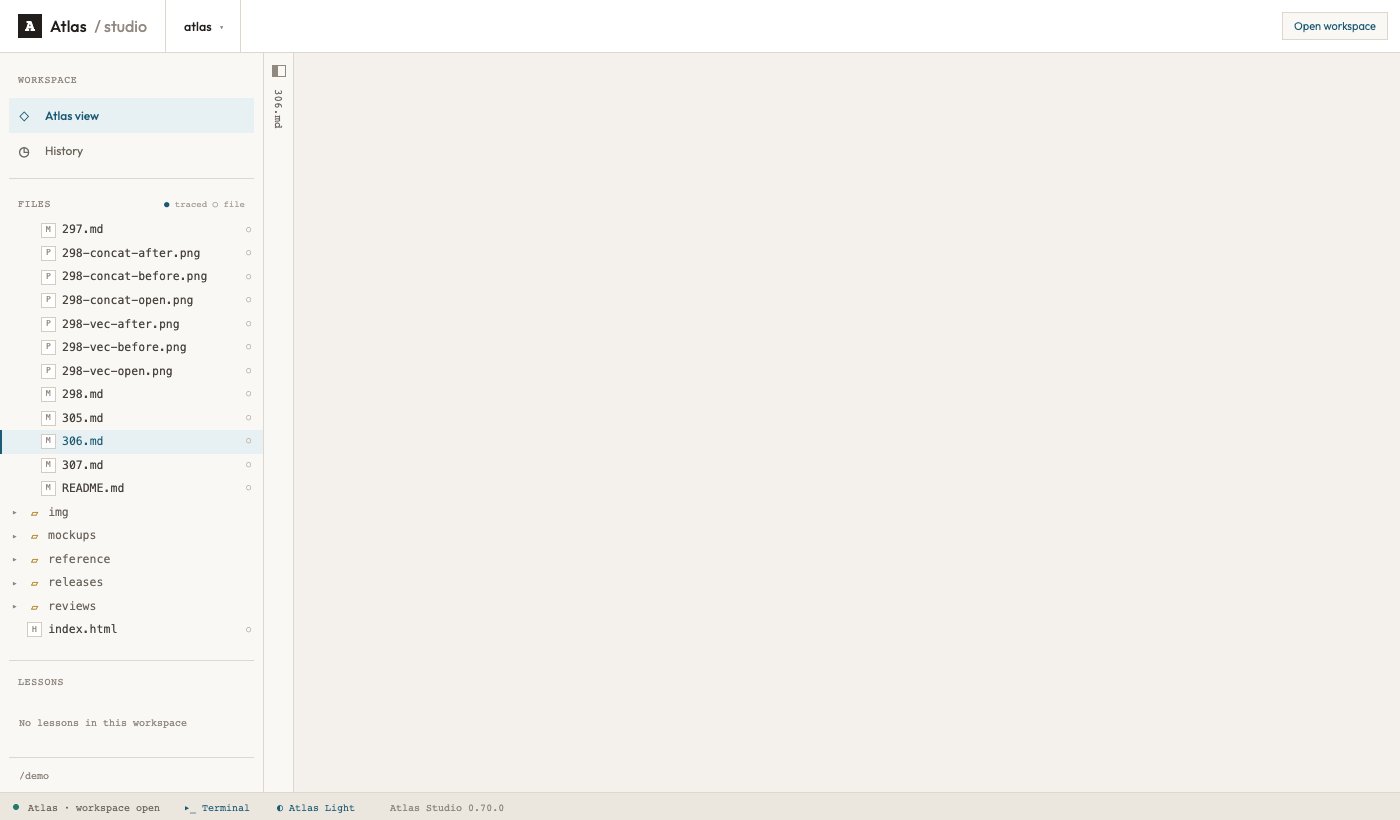
Atlas writes into your tree what it is asked to
Breaking a seal cuts out sealed=.. and nothing else, in every language's marker. A vision lands on the path it names, even where another file has the same name.
The page and the agent keep their notes whole
The page and your agent write the same notes. When both wrote at once, a note could vanish; now a lock between the two makes one wait for the other. atlas serve answers every request within bounds, and what changes something answers only its own page, never another website.
A fault stays where it happens
One panic inside ty, one MCP tool call that fails, one notebook that does not parse: in 0.69.3 any of them ended the whole run. Now that one file is read untyped, that one call answers an error, and everything else goes on.
Letters past z, and an exit status CI can read
Steps past z go on as aa, ab, as a spreadsheet names its columns, so no label names two branches. atlas-code check exits 1 when it has questions and 2 when it could not read.
Setting a finding aside, in check --help
A decision sets a finding of atlas-code check aside with its reason (0.68.0): a comment in the code, or a line of .atlasignore at the top of the repository, a pattern as .gitignore writes one, the principles it answers and the reason after #. atlas-code check --help now shows both forms and the file's format, and so does the guide.
src/sim/particles.py  changes   # in place for the frame rate, see docs/perf.md
src/legacy/** # ported pipeline, rewrite plannedAtlas measures itself, every night
Every night Atlas builds itself, reads itself and a handful of public programs, cold and warm, and runs its tests, and keeps the numbers. A night that is slower than the ones before is only a reason to look: the same run measures that commit against the last good one, turn and turn about on the same machine. Only what that reproduces is reported, and its size says how urgent it is. Every Monday next is held against the last release, so that creep shows too, and any stretch of history can be searched for the landing that made it slower. It all runs at night, so no commit pays for it.
A view of Atlas in about a second
Drawing a view worked out what every function reads back and changes again and again, each time copying what it already knew; reading a program walked each function body again for every name it followed. Now each answer is kept once and shared, and a body is read once for every question its steps ask. The picture is the same, byte for byte; on Atlas itself a warm view takes about a fifth of the time and a third of the memory (561 MB at its peak before, 211 MB after), and a cold one about a third of the time.
A picture too dense to read an order in lays out at once
Within a layer, Atlas keeps the boxes in the order the code gives them: types by name, steps in the order they are called. ELK keeps that order by sorting each layer against every line that passes through it, which grows with the square of the layer. In the picture of a route or a package, at most about 200 lines, that costs nothing; in the overview of atlas-engine with its tests open, 750 lines and too many boxes to read an order in, it took ten seconds. A picture of more than 400 lines is now laid out by its crossings alone and opens in about a second; every smaller picture is drawn as before, pixel for pixel.